
From Pamphlets to TikTok: Nepal’s Movements Across Generations
By Sanman Thapa | 9/15/2025
—***—

Demonstrators gathered outside Nepal’s Parliament in Kathmandu on Monday. One organizer said events this week escalated out of their control. Prabin Ranabhat/Agence France-Presse — Getty Images
I originally wrote this piece as an op-ed right after September 12, when The Guardian and Al Jazeera reported that former Chief Justice Sushila Karki was sworn in as Nepal’s first woman interim Prime Minister. Though the immediate moment has passed, the questions of progress, leadership, and history repeating itself remain deeply relevant.
When my son Aiden asked if today’s youth-led uprising in Nepal is like the People’s Movement of the 1990s, I hesitated. His question drew a line across time — between my youth in Nepal and his perspective now as a teenager in America.
At first glance, the two movements look alike: both fueled by frustration, both demanding dignity and justice. But Gen Z’s revolt is not about TikTok bans, as the headlines suggest. It is about decades of broken promises, corruption, and the forced exile of an entire generation.
The 1990s: Courage in Isolation
In the early 1990s, Nepal’s streets surged with protests against the monarchy. News traveled slowly through pamphlets, rumors and crackling radios. To march meant risking arrest, torture or worse. My own maternal uncles marched. They risked beatings, and their courage shaped my understanding of what it means to resist, even when the outcome was unclear.
We thought sacrifice would build a better country. But the dream curdled. Many revolutionaries who once endured prison and exile betrayed the very people they swore to serve.
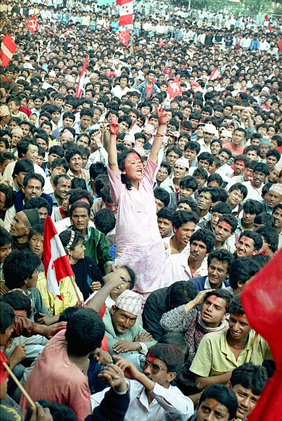
K.P. Sharma Oli is one of them. A native of Jhapa, he rose from the 1970s communist rebellion and built his reputation as a revolutionary behind prison walls. But decades later, as prime minister, he became the authority he once resisted.
In September 2025, under his watch, the government banned 26 social media platforms to silence critics. Gen Z refused. They marched. They livestreamed. They organized in real time. On Sept. 8, security forces opened fire, killing 19 protesters in a single day, according to Reuters.
By Sept. 12, the death toll had climbed to about 51, with more than 1,300 injured, according to Nepal’s Health Ministry and international outlets. Demonstrators torched Parliament and government buildings. Local media reported arson at the Supreme Court and attacks on politicians’ residences. Oli resigned Sept. 9. The army now patrols Kathmandu under curfew.
The rebel of Jhapa had become the gatekeeper of repression.
The People’s War, and its scars
Pushpa Kamal Dahal, known as Prachanda, tells a similar story. From 1996 to 2006, he led the Maoist insurgency that promised liberation. But the so-called People’s War came at a staggering cost: more than 17,000 lives lost, over 1,300 disappeared, and tens of thousands displaced, according to Nepal’s Truth and Reconciliation Commission. Families are still searching for answers.
The violence did not spare the young. Children were handed rifles instead of pens. They believed they were building a just Nepal, but they inherited trauma and poverty.
When Prachanda entered government, his promise evaporated. Corruption flourished. Power-sharing replaced revolution. And the very youth who carried rifles for him were left behind — without support, education, or justice.
The Roots of Gen Z’s Anger
Even after the war ended, its scars lingered. And for many, survival meant leaving Nepal altogether.
To understand today’s protests, you must look beyond the headlines. For my family, it is not abstract. My brother and sister-in-law have been in Dubai for decades, sending money home while paying the price of separation. Another brother spent years in Malaysia, Yemen and East Timor, chasing work that always slipped away.
And then there is me. My own exit came after losing my hand in a factory accident — a loss that pushed me to search for survival in America.
Each time I returned to my village — in 2006, 2008, 2011, 2018, 2019, 2023 and again in 2025 with Aiden — I saw fewer young adults. The houses were quiet, guarded by children and the elderly, waiting for the next money transfer. Some migrants came home sick. Others came back in coffins. Aiden saw this with his own eyes this summer: half-empty villages, futures stolen long before TikTok was ever banned.
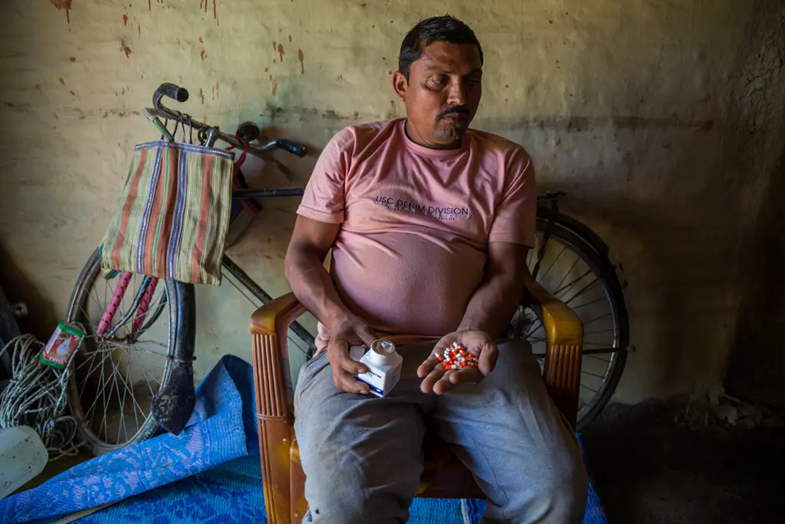
Shambhu Chaudhary with the pills he takes to control dizziness, a lingering effect of his years working in extreme heat. He said workers were docked two days’ pay for every day they were sick. Purnima Shrestha for The New York Times
Exported labor has become Nepal’s economic backbone. In the past year alone, 650,000 Nepalis left on foreign employment contracts, and their remittances make up a quarter of the nation’s GDP, according to the New York Times.
But the cost is brutal. A Guardian investigation reported that more than 6,500 South Asian migrant workers had died in Qatar since it won the World Cup bid, including at least 1,641 Nepalis. Nepal’s own labor ministry confirmed more than 2,100 Nepalis have died in Qatar since 2010, with thousands more in Malaysia, Saudi Arabia and the UAE.
Gen Z grew up in the shadow of this displacement. They are the children of absent parents, of broken promises that education would lead to opportunity, of a country that kept letting its youth slip away. Their protests are not only about censorship. They are about decades of betrayal.
First sign of progress:
On Sept. 12, former Chief Justice Sushila Karki was sworn in as interim prime minister — the first woman in Nepal’s history to hold the office, Reuters reported. She had earlier signaled she would accept after being proposed by protest leaders.
For Gen Z, this moment is not only about censorship. It is about decades of betrayal — and the determination to break the cycle.
_***_
 Sanman Thapa
Leave a comment