
By Sanman Thapa/ Feb.20, 2024, 11:30 AM
The inquiry about the origins of my injury, particularly from my son Aiden, seemed to be a recurring theme in my daily life. Aiden, in his toddler innocence, never failed to ask about my boo-boo. It’s a question that arose more often than I’d prefer. At his tender age, he lacked the comprehension to grasp the details of how it happened. So, I simply told him, “Daddy got his boo-boo from a big machine.” Yet, I wondered how he interpreted the notion of the “big machine” that took his daddy’s hand.
As he matured, his linguistic abilities flourished, progressing from simple exclamations like “boo-boo” to nuanced inquiries such as “no fingers,” then “no hand,” and finally, to probing questions like “How did you lose your hand? What type of machine was involved? How did the incident occur? What were you doing at the time?”
I would recount the incident, explaining that it occurred in a shoe factory. However, I would transition into the tale of how I found myself working in the shoe manufacturing industry. Unfortunately, he had no patience for my lengthy life narrative at that moment.
Now, 14 years old, he has already visited Nepal four times, exploring both my rural village and the bustling streets of Kathmandu, where I endured the loss of my hand. I never missed an opportunity to remind him of his privileged circumstances. Aiden often responded with a hint of frustration, “I get it, Dad. You’ve told me the hardships of your life in Nepal a thousand times.”
When I recount my childhood story to Aiden, it invariably began in the remote corners of Nepal. At the age of seventeen, I left my hometown in pursuit of higher education, stable employment, and the means to support my family. My destination was Kathmandu, the bustling capital, yet the job hunt proved to be more challenging than anticipated. Eventually, I landed a position that required me to balance a rigorous 13-hour shift at a garment factory while striving to attend college.
Upon my initial arrival at the factory, I found myself engulfed by the enormity of the structure and the bustling activity of the workers, resembling ants in their seamless coordination. Each individual diligently performed their designated tasks within various sections and stations of the factory floor. The array of machinery, including sewing, kaaj, Bartacking, and cutting machines, occupied numerous stations, the dissonance of these machines resonated like a chorus of buzzing bees in my ears.
A multitude of fabric bundles spread across the vast expanse of the room, reaching from floor to ceiling. Unfinished garments cluttered every corner, each station dedicated to a different stage of production: some sewing, others punching buttonholes and still others were attaching buttons. Operators’ gazes were fixed on their machines, their hands and feet moving in perfect harmony.
The location was packed with people; approximately 150-175 workers were utilizing three toilets. These facilities were all linked to a single enormous septic tank, its protective covering worn and cracked, emanating a foul stench of sewage. Overflow from the tank would often spill into the exposed drainage leading to the water pump.
When mealtime arrived, I teamed up with fellow workers: one prepared the main courses, while another handled the dal and vegetables. Securing a brick-heater stove was a challenge due to insufficient supply for all of us. With only two water pumps available, we had to juggle tasks like washing utensils, bathing, and cleaning clothes efficiently.
I lacked a room or bed for rest. After my shift concluded at midnight, I loitered and surreptitiously entered the warehouse. I settled atop a pile of fabric, employing loose material as a makeshift blanket. Sleeping there posed a risk of being caught and facing repercussions, yet I had no alternative. Because of insufficient eating and sleeping, coupled with extensive work hours spanning 13 hours a day, six days a week, my health eventually deteriorated.
I couldn’t work there any longer. I secured a position at a different Garment Factory as a Machine Operator. Although I was relatively inexperienced in this role, I had to work swiftly as I was paid per piece. Unfortunately, there were numerous incidents where the needle pricked my fingers. Those painful memories are still sewn into my fingertips.
As I was settling in and beginning to earn a decent income, all the garment industries in Kathmandu Valley shuttered their operations due to the efforts of environmental activists aiming to keep Kathmandu clean. Consequently, I found myself unemployed for a couple of months. Feeling adrift, I wandered from one store to another, inquiring if they had any vacancies but with no luck.
After a month of unsuccessful job hunting, I decided to humble myself and appeal to the older brother of a high school classmate for a job at Venus Shoe Factory, a plastic and shoe manufacturing facility where he served as a supervisor. He kept delaying for a month until I informed him that I had no other options and hinted at the possibility of needing his support. Reluctantly, he agreed to schedule an interview with the company manager. During the interview the manager inquired about my past experiences. Despite my lack of direct experience in the shoe industry, he decided to hire me due to my year and a half of demanding work in a garment factory.
In the beginning, my role was that of an assistant, maneuvering hot iron insole molds for a hydraulic shoe compression machine for extended 12-hour shifts. The work was grueling, often leaving me on the verge of exhaustion. There were moments when I inadvertently dozed off on the mold, occasionally waking up with a burning sensation on my forehead. Fortunately, the machine operator, a compassionate and friendly individual, took pity on me. He would allow me to take short breaks and rest for a couple of hours in the storage room.
Despite enduring long hours, my sleep pattern was consistently disrupted by my ever-shifting schedule. The company mandated that all employees rotate between day and night shifts every two weeks. When I inquired about the rationale behind this policy, the response was vague, suggesting the company aimed to prevent employees from becoming too complacent with their shifts.
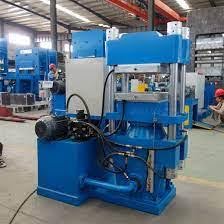
Over time, I became proficient in operating a precision hydraulic press and rubber parts-making machine designed to operate at temperatures of 500 degrees Celsius. The machine featured three manual levers: one for opening the disk, another for closing it, and a third for injecting the raw material. The raw material undergoes high-temperature heat, transforming it from solid rubber into a liquid state before being injected into the mold.
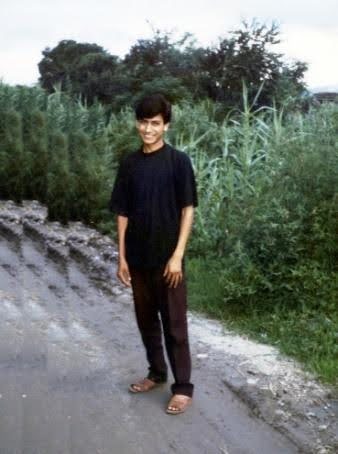
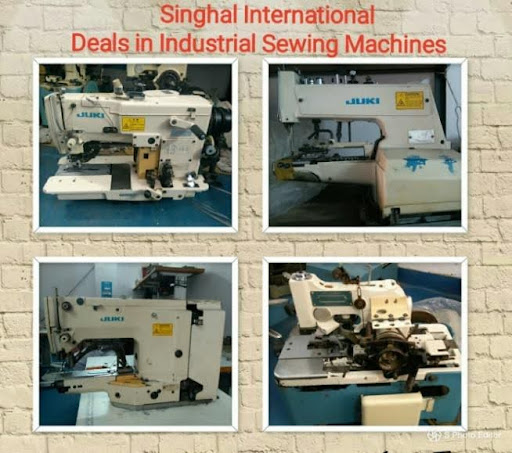
The initial image depicts the scene before the accident, followed by a glimpse of machinery within the garment factory in the second picture. The third prominent blue image bears a resemblance to the one responsible for injuring my hand.
I had a cooperator; one operated the machine while others checked and counted the products and packed them in the sacks. We needed 1,500 pairs per night; the supervisor did not care if we slept all night or worked throughout the night as long as we produced and met the quotas. Therefore, my partner and I alternated between working and resting for a few hours at a time.
On this particular evening, I felt utterly exhausted and decided to inquire with my coworker if I could take a nap earlier than usual. To my relief, he gladly consented, and I went to sleep at 11:30 pm. Upon being awakened by him, I was surprised to find it was nearly 3:00 am; he had generously granted me an extra hour and a half of sleep. Upon waking up, I ventured outside, rejuvenated myself by splashing water from the pump onto my face, and took a seat on the operating chair.
He had thoughtfully prepared tea for me, complete with a side of biscuits. I expressed my gratitude for both the tea, the biscuits, and for allowing me to catch up on some extra sleep. He reassured me, saying there was no need to mention it, before heading to the storage room for a nap. While enjoying my tea, I effortlessly operated the machine, relying on muscle memory as the tasks had become so routine that I didn’t need to consciously think about each step.
However, the nozzle consistently became clogged, necessitating frequent removal of scraps lodged between the disks. Meeting the shift quota was imperative, leaving little room for error with damaged products.
During the process of nozzle maintenance, I inadvertently activated the lever to close the two disks, unaware that my hand was caught between them. It wasn’t until I heard the crunch that I realized my hand had been crushed. In a state of panic, I swiftly attempted to open the disks with the other lever, but alas, it was already too late.
Clutching my injured left hand with my right, I let out a scream before bolting outside. Shock and fear gripped me as I dashed in frantic circles around the courtyard. With delirium clouding my senses, I held onto my wrist tightly, desperate to stem the flow of blood. The darkness of the 3:30 am hour obscured the extent of the damage, compounded by the protection of double-construction gloves against the searing heat of the disks.
My colleagues rushed out in a flurry of activity; one of them grabbed me from behind, embraced me tightly, and guided me to a seat. They quickly summoned our supervisor, who promptly arranged for the company driver to rush me to the hospital. With no time to spare, calling an ambulance, which could take hours, was out of the question.
Upon arriving at the hospital, we were informed that the sole plastic surgeon had left just an hour prior. Despite efforts from the attending nurse and physician to reach him, their attempts proved futile. Enduring three agonizing hours of intense pain, drifting in and out of consciousness, the surgeon finally arrived around 6:30 am. After evaluating the injury, he cautioned me that he couldn’t guarantee outcomes but assured me he would strive to salvage my hand to the best of his ability.
As I emerged from surgery, the harsh truth struck me like a thunderbolt: my hand was no longer there. A tumult of shock, disbelief, and confusion engulfed me, rendering me numb. This pivotal moment, occurring at the tender age of twenty, thrust me into a realm of uncertainty, where the trajectory of my future seemed obscure. It was as though the very foundation of my world had been upended, leaving me adrift in a sea of uncertainty.
###
 Sanman Thapa
Leave a comment